
Demolition activity can generate high levels of airborne dust in a short period of time.
Breaking concrete, dismantling structures, crushing materials, moving debris and loading waste can all release fine particles into the air, often across changing areas of a site.
ODS provides demolition dust suppression and environmental monitoring solutions for projects throughout Scotland.
Based in Ayrshire, we supply mobile, temporary and fixed systems designed to control dust close to the source and help reduce its movement across the wider site.
Demolition sites can create dust from several activities at once.
Common sources include:
Because demolition work progresses quickly and dust sources can move from one part of the site to another, flexible suppression systems are often particularly useful.
Mechanical demolition can produce concentrated airborne dust as structures are broken apart.
Excavators, breakers and other heavy plant can disturb large volumes of concrete, brick, mortar and other construction materials.
Applying fine water droplets close to the demolition activity can help capture airborne particles before they travel across the site.
Depending on the scale of the work, suitable systems can include:
Mobile equipment can be repositioned as demolition activity progresses through different parts of the site.
Fog cannons are particularly well suited to demolition environments where dust is generated across a relatively large or moving area.
They produce a fine mist designed to interact with airborne dust and bring particles back towards the ground.
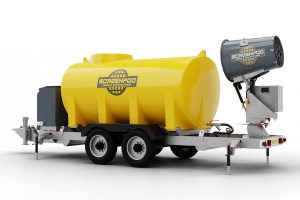 Typical demolition applications include:
Mobile fog cannons can follow the work as demolition progresses, while fixed units may be suitable for longer-term activity within a defined area.
Different units can provide different throw distances and coverage depending on the size and layout of the site.
View all ScreenPod Dust Cannons
Read more about Fog Cannons
Where the source of dust is more defined, nozzle systems can provide more targeted suppression.
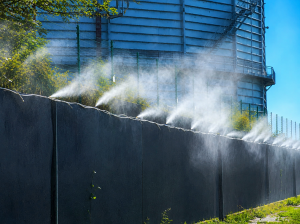
They can be positioned close to:
Targeting the source can reduce the need to apply water across areas where it is not required.
This can be particularly useful where excessive water could interfere with materials, create additional runoff or make working surfaces difficult to manage.
Read more about Nozzle Systems
Crushing concrete and other demolition materials can generate significant quantities of fine airborne dust.
Where crushing is carried out on site, suppression can be positioned around the crusher, feed area and discharge points.
Options may include:
The most effective solution depends on the crusher layout, material type and working area.
Demolition sites often involve temporary stockpiles of crushed concrete, brick, soil and other materials.
These can generate dust during:
Mobile fog cannons, sprinklers or nozzle systems can be used to provide localised suppression around stockpile areas.
Because these locations may change throughout the project, temporary systems can offer greater flexibility than permanent installations.
Dust generated by demolition does not only come from the building itself.
Vehicles moving around the site can continually disturb fine material deposited on temporary roads, yards and access routes.
Dust suppression options for these areas can include:
Regular treatment of active routes can help reduce dust created by plant and HGV movements.
Dust monitoring can provide greater visibility of changing particulate levels during demolition works.
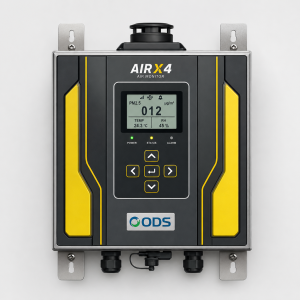
Monitoring equipment can be positioned around:
Depending on the system selected, monitoring can provide continuous measurements and alerts when predefined thresholds are reached.
This can help site teams identify periods of increased dust and decide when additional suppression may be required.
Read more about Dust Monitoring
Demolition often takes place in built-up environments where neighbouring properties may be relatively close to the work.
Dust can travel beyond the immediate demolition area depending on wind, weather and the type of activity being carried out.
Sensitive locations can include:
Where boundary dust is a concern, combining source suppression with environmental monitoring can help site teams manage changing conditions more effectively.
Urban demolition can present additional challenges because of limited space, nearby buildings and restricted access.
Equipment may need to operate within tight working areas while still providing adequate coverage.
Mobile fog cannons, compact atomisers and targeted nozzle systems can be useful where larger fixed installations are impractical.
Site layout, available water and the proximity of neighbouring properties should all be considered when selecting equipment.
Larger demolition projects may involve several active areas at the same time.
Different parts of the site may require different suppression methods.
For example:
Using several systems together can provide more effective control than relying on a single piece of equipment to manage the whole site.
Water is widely used to control demolition dust, but excessive application can create additional problems.
These can include:
The aim is to apply water in the correct form and location.
Fine mist may be more suitable for airborne dust, while heavier surface application may be required on haul roads or dry working areas.
More targeted suppression can help reduce unnecessary water use.
This may involve:
A flexible approach allows suppression to follow the work rather than continuously treating areas where dust is not being generated.
Demolition projects are temporary by nature.
For many contractors, permanent dust suppression infrastructure is therefore unnecessary.
Temporary systems can be installed or deployed for the duration of the project and repositioned as work progresses.
Suitable equipment can include:
This can provide effective dust control without requiring permanent installation across the site.
Depending on the project, dust suppression equipment may be required for only a few weeks or several months.
Temporary hire can be suitable for:
Longer-term projects may benefit from purchased or semi-permanent systems.
Selected ODS equipment can be available for hire or purchase depending on the system and application.
ODS is based in Stewarton, Ayrshire and provides demolition dust suppression and monitoring solutions throughout Scotland.
We can support projects across:
Different demolition environments create different dust-control challenges.
An inner-city redevelopment may require compact equipment and careful boundary monitoring, while a larger industrial demolition site may allow wider use of fog cannons, bowsers and temporary sprinkler systems.
ODS operates from Ayrshire and supports demolition, construction and industrial projects throughout Scotland.
Mobile systems can be repositioned as demolition progresses and dust sources change.
Fog cannons, atomisers, nozzles, sprinklers, bowsers and monitoring equipment can be selected according to the application.
Suppression equipment can be combined with monitoring to provide greater visibility of changing site conditions.
Equipment can be suitable for short-term demolition projects as well as longer construction programmes.
Site size, demolition method, neighbouring properties, water availability and access can all influence the most appropriate solution.
If demolition, crushing, material handling or vehicle movements are generating dust on your site, ODS can help identify suitable suppression and monitoring options.
Tell us what work is taking place, where dust is being generated and how the site is laid out.
We can discuss the available systems and identify an approach suited to the project.
Common sources include breaking concrete, mechanical demolition, crushing, cutting, loading debris, stockpiles and vehicle movements across dry surfaces.
There is no single system suitable for every project. Fog cannons are often useful for larger airborne dust sources, while nozzles and misting systems can provide more targeted control around crushers and defined work areas.
Yes. Fog cannons are commonly suited to demolition applications because they can provide broad coverage and can be repositioned as work progresses.
Yes. Nozzle systems, fine mist and fog cannons can all be used around crushing operations depending on the equipment and site layout.
Yes. Dust monitoring equipment can be positioned around site boundaries, active work areas and nearby sensitive locations.
Source suppression can help reduce the amount of airborne dust leaving the active work area, while monitoring can provide greater visibility of conditions around site boundaries.
Selected ODS equipment can be available for temporary hire depending on the system and project requirements.
Yes. Mobile and temporary systems can be repositioned as active demolition areas move around the site.
Yes. ODS is based in Ayrshire and supports demolition projects throughout Scotland.