
Construction activity can generate dust from excavation, demolition, cutting, vehicle movements, stockpiles, haul roads and material handling.
Without suitable controls, dust can spread across the site and beyond the site boundary, affecting workers, neighbouring properties and surrounding areas.
ODS provides dust suppression and monitoring solutions for construction projects throughout Scotland.
From mobile equipment for temporary works to more permanent suppression systems, solutions can be selected according to the type of activity, site layout and project duration.
Discuss Your Construction Site
Explore Dust Control Solutions
Dust can be generated throughout different phases of a construction project.
Common sources include:
Because construction sites change as work progresses, the location and intensity of dust generation can also change significantly throughout the project.
Excavation, grading and movement of dry soil can release large amounts of airborne dust.
Mobile suppression systems can provide targeted control as work moves across the site.
Demolition activities can generate concentrated airborne dust over relatively short periods.
Fog cannons and nozzle systems can help suppress dust close to the source.
Explore → Demolition Dust Suppression Scotland
Temporary roads and vehicle movements are often persistent sources of dust throughout construction.
Bowsers, sprinklers and road treatment systems can be used to control dust along heavily trafficked routes.
Explore → Haul Road Dust Suppression Scotland
Soil, aggregate and other loose materials can generate dust during storage, loading and movement.
Fixed or mobile suppression equipment can provide targeted treatment around these areas.
Dust generated at defined processing points can often be controlled using localised misting or nozzle systems positioned close to the source.
Fog cannons generate fine water droplets designed to capture airborne dust close to where it is produced.
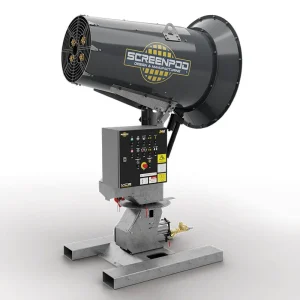
They can be suitable for:
Mobile fog cannons can be repositioned as construction activity moves across the site.
Explore → Screenpod Fog Cannons
Explore → Fog Cannons
Water bowsers provide mobile dust control across haul roads, compounds and larger site areas.
They can be particularly useful where the dust source changes or permanent infrastructure is not practical.
Explore → Dust Suppression Bowsers
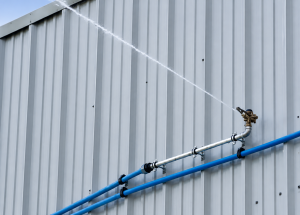
Temporary sprinkler systems can provide regular treatment across haul roads, compounds and other high-traffic areas.
Automated systems can reduce the need for repeated manual watering where suitable.
Explore → Sprinkler Systems
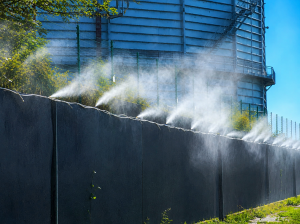
Nozzle systems can target individual dust sources such as processing equipment, stockpiles, loading areas and site boundaries.
Different configurations can be designed according to the required coverage and application.
Explore → Dust Suppression Nozzles
Dust suppression controls the source, while monitoring can help site teams understand changing particulate levels around the project.
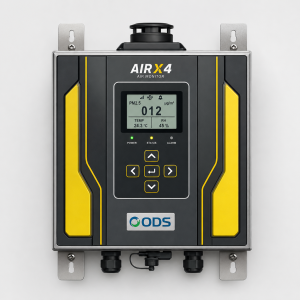
Dust monitors can be positioned around:
Depending on the system selected, monitoring can provide continuous measurements and alerts when predetermined thresholds are reached.
This can help site teams identify changing conditions and determine when additional dust-control measures may be required.
Explore → Dust Monitoring
Construction sites are rarely static.
Excavation may take place in one area before work moves to foundations, infrastructure, building construction or landscaping.
For this reason, temporary and mobile suppression systems can offer significant flexibility.
Equipment such as:
can be repositioned as the project develops.
Effective dust suppression does not necessarily mean using more water.
Too much water can create additional problems, including:
The objective is to apply water where it is required and in a form appropriate to the dust source.
A haul road may require surface watering, while airborne dust from demolition or material handling may be better controlled using fine mist closer to the source.
Not every Scottish construction project has easy access to mains water and power.
Remote infrastructure, renewable energy and rural developments may involve:
Mobile and self-contained dust suppression equipment can provide greater flexibility in these environments.
ODS can consider site infrastructure alongside the dust-control requirement when identifying suitable options.
Construction projects are temporary by nature, so purchasing equipment is not always the most practical option.
Depending on the system required, ODS can provide equipment for hire or purchase.
Hire can be particularly useful for:
Ask About Dust Suppression Hire
ODS is based in Ayrshire and provides dust suppression and monitoring solutions for construction projects throughout Scotland.
We can support projects across areas including:
ODS operates from Ayrshire and supports construction projects throughout Scotland.
Different sources of dust require different solutions. ODS can provide fog cannons, bowsers, sprinklers, nozzle systems and monitoring equipment.
Selected equipment can be supplied for temporary hire or longer-term use.
Dust suppression and monitoring systems can be used together where greater visibility of site conditions is required.
Project size, dust source, water availability, site access and working conditions can all influence the most appropriate system.
Tell us what activities are generating dust, where the problem is occurring and how the site is operating.
ODS can discuss the available dust suppression and monitoring options and help identify a suitable approach.