
Haul roads and temporary access routes can become major sources of dust where heavy vehicles repeatedly travel across dry or unsealed surfaces.
ODS provides haul road dust suppression solutions for projects and operational sites across Scotland, including construction sites, quarries, wind farms, industrial facilities and remote developments.
Depending on the site, solutions can include mobile water bowsers, sprinkler systems, nozzle systems and road dust suppression treatments.
Discuss Your Site
Explore Dust Suppression Solutions
Heavy plant and HGV movements continuously disturb loose material on road surfaces.
During dry conditions, fine particles can become airborne every time a vehicle passes.
Dust generation can increase because of:
On larger sites, haul roads can remain one of the main sources of airborne dust throughout the working day.
I would make this a card/grid section.
Wind farm construction can involve long temporary access roads and repeated movements of heavy construction traffic across remote sites.
Explore → Wind Farm Dust Suppression Scotland
Quarry haul roads can experience continuous movements from dump trucks, loaders and other heavy plant.
Dust suppression can help control emissions along internal routes and operational areas.
Explore → Quarry Dust Suppression Scotland
Large developments, earthworks and infrastructure projects can require temporary haul routes for plant and HGV traffic.
Explore → Construction Dust Control Scotland
Vehicle movements across yards and internal roads can contribute significantly to airborne dust, particularly during dry weather.
Explore → Waste & Recycling Solutions Scotland
Bulk material handling, stockpiles and regular HGV movements can create persistent road dust around industrial operations.
There is no single system suitable for every site.
The best approach depends on the road length, surface material, traffic level, water availability and how frequently the road needs to be treated.
Mobile water bowsers are one of the most flexible methods of controlling dust across haul roads and access routes.
They can travel directly along the road and apply water to the surface where it is required.
Bowsers can be particularly useful where:
Explore → Dust Suppression Bowsers Scotland
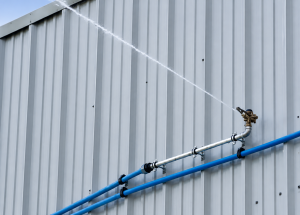 Sprinkler systems can provide regular treatment along sections of haul road or around high-traffic areas.
They may be suitable for routes where repeated manual watering would otherwise be required.
Temporary systems can also be repositioned as site operations change.
Explore → Sprinkler Systems
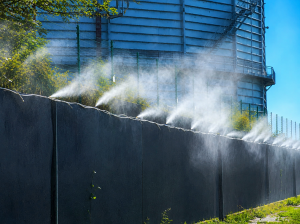
Nozzle systems can be positioned around specific sections of road, junctions, loading areas or other locations where dust generation is concentrated.
Different spray patterns can be used depending on the application.
Explore → Dust Suppression Nozzles
Where repeated watering is inefficient or water availability is limited, surface treatments may help reduce the amount of fine material becoming airborne.
The suitability of any treatment depends on the road material, operating conditions and environmental requirements.
Simply applying more water does not necessarily provide better dust control.
Too little water may dry quickly and provide only short-term suppression.
Too much water can create:
The objective is to maintain enough moisture in the road surface to suppress dust without oversaturating it.
Application frequency may need to change depending on weather, traffic and surface condition.
Water availability can be a major consideration on remote or large sites.
More efficient dust suppression can involve:
Selecting the right equipment can reduce unnecessary water use while maintaining effective dust control.
Dust monitoring can help site operators understand when particulate levels increase and where additional suppression may be required.
Monitoring equipment can be positioned around:
Depending on the monitoring system, alerts can be generated when particulate levels reach predefined thresholds.
Explore → Dust Monitoring
Many projects in Scotland operate in rural or remote locations where access to mains water and power may be limited.
These sites can also involve long internal roads and large distances between operational areas.
Mobile or self-contained dust suppression equipment can provide greater flexibility where fixed infrastructure is not practical.
ODS can help identify options based on:
Dust problems can be temporary or ongoing.
Temporary haul roads may only need suppression during the construction phase, while quarries and industrial sites may require long-term dust control.
ODS can provide solutions suitable for:
Depending on the equipment required, systems may be available for hire or purchase.
ODS is based in Ayrshire and supports sites across Scotland.
Haul road dust suppression may be required on projects throughout:
ODS operates from Ayrshire and provides dust suppression equipment and site solutions across Scotland.
Different haul roads require different approaches, from mobile watering systems to sprinklers and surface treatments.
Solutions can be selected for short-term construction projects or longer-term operational sites.
Dust suppression can be combined with environmental monitoring where greater visibility of site conditions is required.
Traffic, road surface, water availability, terrain and project duration can all influence the most suitable solution.
Tell us about the road length, surface material, expected traffic levels and available water supply.
ODS can discuss the available options and help identify a suitable dust suppression approach.
The best method depends on traffic levels, road material, climate, available water and road length. Common options include water bowsers, sprinkler systems, nozzle systems and road dust suppression treatments.
There is no fixed interval. Watering frequency depends on weather conditions, traffic levels, road condition and how quickly the surface dries.
Selected ODS equipment can be available for hire depending on the system and project requirements.
Yes. Mobile and temporary systems can be particularly useful where fixed water or power infrastructure is limited.
Yes. Dust monitoring systems can be used alongside suppression equipment to track particulate levels around haul roads and site boundaries.
Yes. ODS is based in Ayrshire and supports projects throughout Scotland.