
Ports, harbours and marine industrial sites can generate dust, odour and other environmental challenges through bulk material handling, vehicle movements, storage, loading operations and maintenance activities.
ODS provides environmental control and monitoring solutions for ports, harbours and associated industrial operations throughout Scotland.
Based in Ayrshire, we supply mobile, temporary and fixed systems that can be selected around the individual site, material and operational requirement.
From dust suppression around stockpiles and loading areas to environmental monitoring at site boundaries, ODS can help identify practical solutions for complex working environments.
Port and harbour operations can involve several activities taking place simultaneously across large sites.
Depending on the facility, environmental issues may arise from:
Because these activities can be spread across a large area, a single environmental control system may not be suitable for every part of the site.
Targeted suppression can be used around individual dust sources while larger mobile or fixed systems control wider operational areas.
Bulk materials can generate airborne dust during loading, unloading, transfer and storage.
The level of dust generated will depend on the material being handled, moisture content, drop height, weather conditions and handling process.
Dust suppression can be positioned close to the source using:
Controlling dust close to the point where material is released can help reduce its movement into other operational areas.
Read more about Dust Control Solutions.
Loading and unloading can create short periods of concentrated dust as materials are transferred between vessels, vehicles, hoppers or storage areas.
These areas may benefit from targeted systems positioned around the transfer zone.
Depending on the operation, suitable equipment can include:
The most appropriate approach will depend on the size of the loading area, the type of material and whether the operation takes place in a fixed or changing location.
Nozzle systems can provide targeted dust suppression around defined sources.
They may be installed around:
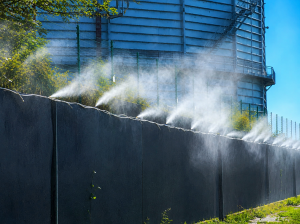
Fine mist can be directed towards the source, helping reduce airborne dust without unnecessarily spraying the wider site.
Nozzle systems can also be incorporated into automated systems where regular suppression is required.
Read more about Nozzle Systems.
Ports handling bulk materials often rely on conveyors, hoppers and transfer systems.
Dust can be generated where material falls, changes direction or is discharged.
These sources are often suitable for localised suppression because the point of dust generation is relatively predictable.
Fine mist nozzles can be installed close to:
Targeting these areas can help control dust before it spreads across the wider facility.
Read more about Nozzle Systems.
Ports and industrial harbour sites may store aggregate, minerals, recycled materials, biomass or other bulk products in open stockpiles.
These materials can generate dust during:
Suppression systems can provide regular treatment around stockpile areas and help reduce the movement of airborne material.
Depending on the size and layout of the storage area, suitable options can include sprinklers, nozzles, atomisers or mobile fog cannons.
Sprinkler systems can provide broad-area dust suppression across stockpiles, yards and frequently trafficked surfaces.
They may be suitable for areas where repeated treatment is required throughout the working day.
Applications can include:
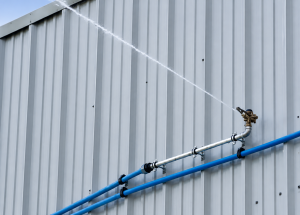
Automated sprinkler systems can help provide more consistent coverage where permanent or semi-permanent treatment is required.
Read more about Sprinkler Systems.
Fog cannons can provide broader coverage where dust is generated across larger or changing working areas.
They can be particularly useful around:
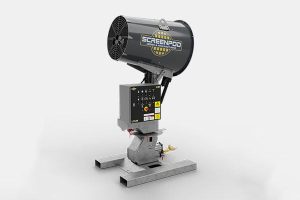
Mobile units can be repositioned as activity moves around the site, while fixed systems may be suitable where dust is repeatedly generated in the same location.
Read more about Dust Cannons.
HGVs, loaders and other heavy plant can generate significant dust as they move across dry yards and internal roads.
Fine material deposited on surfaces can be repeatedly disturbed throughout the working day.
Dust suppression for vehicle routes can include:
The appropriate system will depend on traffic levels, route length, surface material and available water.
Read more about Haul Road Dust Suppression Scotland.
Environmental monitoring can provide greater visibility of changing site conditions.
Dust monitors can be positioned around:
Depending on the system selected, monitoring can provide continuous particulate measurements and alerts when predetermined thresholds are reached.
This can help site teams identify periods of increased dust and assess whether additional control measures are required.
Read more about Dust Monitoring.
Ports and harbours can sit close to residential, commercial and public areas.
Monitoring around the site boundary can help provide a clearer picture of environmental conditions where industrial activity meets the surrounding community.
Potential monitoring locations may include:
Monitoring locations should be selected around the individual site layout and environmental requirements.
Monitoring and suppression can form part of the same dust-management approach.
Monitoring helps identify changing particulate levels, while suppression equipment provides active control around the source.
This can allow site operators to focus dust-control measures on the activities and locations generating the greatest impact.
For larger port or harbour sites, several monitoring and suppression technologies may be used across different operational areas.
Some port and harbour operations may also experience odour issues.
Potential sources can include:
Where odour is generated from a defined source, nozzle or atomiser systems can provide targeted treatment.
Larger systems may also be used around open storage or operational zones where wider coverage is required.
Atomiser systems generate fine droplets that can be used across applications involving dust, odour or other nuisance emissions.
They may be suitable for:

Static systems can provide consistent treatment around fixed sources, while mobile systems can be repositioned as operational requirements change.
Read more about Atomiser Systems.
Many harbour locations support more than vessel movements alone.
They can include:
These activities can create a combination of dust, odour and environmental monitoring requirements.
ODS can consider the individual sources and recommend systems for specific operational areas rather than treating the whole site as one problem.
Ports and harbours regularly undergo construction, refurbishment and maintenance.
Activities such as excavation, demolition, surface preparation and vehicle movements can create temporary dust sources alongside normal port operations.
Temporary suppression equipment can be deployed around these activities and removed or repositioned as work progresses.
Suitable options can include:
Read more about Construction Dust Control Scotland.
Redevelopment of older port infrastructure can involve demolition of warehouses, structures, hardstanding and industrial facilities.
These activities can generate concentrated airborne dust, particularly during concrete breaking, crushing and debris handling.
Mobile fog cannons and targeted misting systems can provide flexible suppression as work moves across the site.
Dust monitoring may also be used around boundaries or nearby operational areas.
Read more about Demolition Dust Suppression Scotland.
Ports and harbours are often exposed to changing coastal weather conditions.
Wind can increase the movement of dry material from stockpiles, yards and active handling areas.
This makes the position and operation of dust suppression equipment particularly important.
Site conditions may require adjustments to:
A flexible system can allow operators to respond as conditions change.
Water can be highly effective for dust suppression, but excessive application may create unnecessary operational problems.
These can include:
Different dust sources require different droplet sizes and application methods.
Fine mist may be more suitable around airborne dust from material transfer, while road and yard surfaces may require a heavier application.
Targeting each source appropriately can help reduce unnecessary water use.
Ports and harbours often require a combination of permanent and temporary systems.
Fixed nozzle, sprinkler and monitoring systems can be suitable around permanent infrastructure such as conveyors, stockpiles and material reception areas.
Mobile fog cannons, atomisers and bowsers can be moved between different operational areas.
Temporary equipment can support construction, maintenance, seasonal operations or periods of increased activity.
Combining these approaches can provide greater flexibility across larger sites.
Environmental-control requirements can change according to the operation.
Temporary hire may be appropriate for:
Permanent systems may be more appropriate where dust or odour is generated continuously from an established process.
Selected ODS equipment can be available for hire or purchase depending on the application.
Ports may include waste transfer, recycling or material recovery activities alongside traditional marine operations.
These sites can experience combined dust and odour issues from:
A combination of dust suppression, odour control and environmental monitoring may therefore be appropriate.
Read more about Waste & Recycling Environmental Solutions Scotland.
ODS is based in Stewarton, Ayrshire and provides environmental control and monitoring solutions for ports, harbours and industrial sites throughout Scotland.
We can support operations across the west coast, Central Belt, east coast, north-east and more remote coastal locations.
Sites may include:
The appropriate solution depends on the activity taking place rather than simply the size of the site.
A bulk aggregate terminal may require extensive dust suppression around conveyors, stockpiles and roads, while another harbour may primarily require monitoring or targeted treatment around individual operations.
ODS operates from Ayrshire and supports industrial and infrastructure sites throughout Scotland.
Dust suppression, odour control and environmental monitoring can be considered together where a site experiences several different issues.
Solutions can be selected for permanent infrastructure as well as temporary and changing operations.
Different equipment can be used for roads, stockpiles, transfer points, processing areas and wider working zones.
Monitoring systems can provide greater visibility of changing conditions around working areas and site boundaries.
Material type, site layout, weather exposure, vehicle movements, water availability and surrounding areas can all influence the most appropriate solution.
If dust, odour or environmental monitoring is required at your port, harbour or marine industrial site, ODS can help identify suitable options.
Tell us what activities are taking place, where the environmental issue occurs and how the site operates.
We can discuss the available suppression, treatment and monitoring systems and identify an approach suited to the individual facility.
Common sources include bulk material handling, stockpiles, conveyors, transfer points, loading and unloading, vehicle movements and construction activity.
Dust can be controlled using nozzle systems, atomisers, fog cannons and other suppression systems positioned close to loading, transfer and storage areas.
Yes. Fine mist nozzles can be positioned close to conveyor discharge points, hoppers, chutes and transfer areas to target dust where it is generated.
Options can include sprinkler systems, nozzles, atomisers and mobile fog cannons depending on the material, size of the stockpile and site layout.
Yes. Water bowsers, sprinklers, roadside nozzles and other road dust suppression methods can be used on high-traffic surfaces.
Yes. Dust monitoring systems can provide continuous particulate measurements around site boundaries, operational areas and other selected locations.
Yes. Monitoring and suppression can be used together to provide greater visibility of conditions while actively controlling dust at the source.
Yes. Atomiser and nozzle systems can be used for suitable odour-control applications depending on the source and site conditions.
Selected ODS equipment can be available for temporary hire depending on the system, availability and operational requirements.
Yes. ODS is based in Ayrshire and supports port, harbour and industrial operations throughout Scotland.