
Effective dust suppression for construction sites helps contractors control airborne dust, protect workers, reduce complaints and maintain compliance throughout demolition, groundworks, infrastructure and general construction projects.
Construction activities such as excavation, crushing, cutting, material handling, stockpiling and vehicle movements can generate large volumes of airborne dust. When dust is not controlled at source, it can spread across the site, affect neighbouring properties and create unnecessary environmental and operational risk.
ODS provides construction dust suppression systems across the UK, including dust cannons, mobile atomisers, nozzle systems, sprinklers, bowsers, foam suppression and dust monitoring.
Our team can help identify the most appropriate solution for your site, whether you need temporary equipment hire, a mobile suppression system or a more permanent installation.
👉 Speak to ODS about your construction site
There is no single dust suppression system that works for every construction site.
The right solution depends on:
Most effective construction dust strategies use a combination of suppression equipment, monitoring and operational controls.
Dust cannons are one of the most versatile methods of suppressing airborne dust across construction and demolition sites.
They produce a fine mist that interacts with airborne particles, helping prevent dust from travelling across the site or beyond the site boundary.
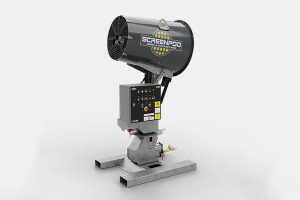 Dust cannons are particularly suited to:
Mobile and trailer-mounted systems can also be repositioned as the site layout changes.
This makes dust cannons particularly useful for temporary construction projects where dust-generating activities move throughout different phases of the work.
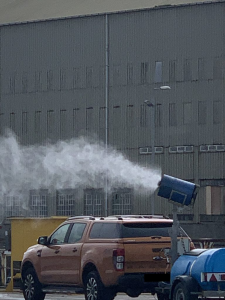
Mobile atomisers provide more localised dust suppression where a large dust cannon may not be required.
They are suitable for areas where mist needs to be directed close to the dust source.
Typical applications include:
Mobile systems can be moved quickly as construction activities progress.
Fixed or temporary nozzle systems can provide continuous dust suppression in areas where dust is generated repeatedly.
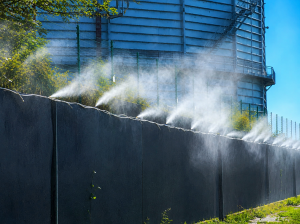 Nozzle systems can be positioned around:
Unlike mobile dust cannons, nozzle systems provide targeted suppression directly where dust is being generated.
This can reduce unnecessary water use while maintaining consistent control.
Vehicle movements on dry or unmade construction roads are a major source of airborne dust.
Repeated movement by excavators, dump trucks and other heavy equipment can generate dust continuously throughout the working day.
Haul road dust can be controlled using:
For larger sites, automated systems can provide more consistent suppression than relying entirely on manual watering.
Demolition projects can create large volumes of dust very quickly.
The most effective approach is generally to apply suppression at or as close as possible to the point where the dust is generated.
Depending on the scale of the demolition, this may include:
Systems can be repositioned as demolition progresses to maintain effective coverage.
Stockpiles can generate dust during dry or windy conditions and when materials are being loaded or removed.
Dust suppression options include:
Controlling stockpile dust is particularly important where stockpiles are located near site boundaries or sensitive neighbouring properties.
Foam dust suppression can be useful where dust is generated continuously at a fixed process point.
Typical applications include:
Foam systems can provide effective dust control using lower water volumes in suitable applications.
Read more about Foam Dust Suppression for Construction Sites.
Water availability can be a significant issue on construction and infrastructure projects.
Some sites may:
Modern systems can reduce unnecessary water use through:
Selecting the right system can improve dust control while reducing water consumption.
Dust monitoring can be used alongside suppression equipment to provide a clearer picture of conditions across the site.
 Monitoring systems can measure parameters including:
Monitoring can help contractors:
On suitable sites, monitoring can also be integrated with suppression systems so equipment activates when predetermined dust levels are reached.
Read more about Dust Monitoring on Construction and Industrial Sites.
Dust leaving a construction site can quickly generate complaints from neighbouring residents, businesses and other sensitive receptors.
Complaints commonly relate to:
A proactive dust suppression strategy can help prevent complaints and demonstrate that appropriate controls are in place.
For more information, visit our Construction Dust Complaints resource.
Construction dust can fall under several health, safety, planning and environmental requirements depending on the type of work and location.
Sites may need to manage:
Effective dust suppression should therefore be considered as part of the wider site environmental management strategy rather than simply as a response to visible dust.
Read more about Construction Dust Control Regulations UK.
Many construction projects require dust control equipment only during specific phases of the work.
Hiring equipment can provide greater flexibility for:
Mobile equipment can be deployed where required and repositioned as the project develops.
For longer projects, a combination of hired equipment and fixed suppression systems may provide the most effective solution.
ODS can provide or design solutions including:
The correct equipment depends on the dust source rather than simply the size of the site.
A demolition project generating large airborne dust plumes may require a completely different solution from a haul road or crusher.
The correct system should consider:
Using equipment that is incorrectly sized or positioned can waste water while still failing to control dust effectively.
ODS can assess the application and recommend a system based on actual site conditions.
Although the terms are often used interchangeably, they describe slightly different approaches.
Dust suppression focuses primarily on preventing or reducing airborne particles using methods such as mist, water, foam or targeted spraying.
Dust control is broader and can include:
For practical guidance on controlling dust across an active site, read How to Control Dust on a Construction Site.
ODS provides practical dust suppression and environmental management solutions for construction and infrastructure projects across the UK.
Rather than recommending a single product for every application, we assess factors including the dust source, site layout, operating conditions and project duration.
Solutions can include:
This allows contractors to use the right equipment for the actual dust problem rather than simply applying more water.
There is no single best system for every site. Dust cannons are often suitable for large airborne dust plumes, while nozzle systems and spray bars are more appropriate for fixed dust sources. Haul roads may require bowsers or sprinklers, while crushers and transfer points may benefit from targeted nozzles or foam suppression.
Dust should normally be suppressed as close as possible to the demolition activity using equipment such as dust cannons, mobile atomisers or targeted misting systems.
Construction haul roads can be controlled using water bowsers, spray bars, sprinkler systems, speed restrictions and regular road cleaning.
Yes. Dust monitoring systems can measure parameters such as PM10 and PM2.5 and can help contractors identify dust events, maintain environmental records and adjust suppression systems.
Yes. Temporary hire is often appropriate for demolition, groundworks and other construction phases where dust-control requirements change throughout the project.
This depends on the system. Fine misting, targeted nozzles, automated activation and monitoring can significantly improve water efficiency compared with uncontrolled spraying.
Every construction site is different.
Whether you need a mobile dust cannon for demolition, haul road suppression, targeted nozzles, dust monitoring or a complete site-wide dust management solution, ODS can help identify the most suitable approach.